Thursday, September 24, 2009

Creating a Bonus for our Affiliate product - Rocket Japanese


We've been wracking our brains to come up with a *BONUS* that we can create or put together for the people who are interested in purchasing Rocket Japanese through us.

We know that it's got to be useful, relevant and most of all, extremely attractive to the people who are interested in learning how to speak and write in Japanese.

Hopefully, this bonus will also be a complement to what's already being offered in the already excellent Rocket Japanese program.

Most importantly, it has to be simple and straightforward. There's already a multitude of resources all over the Internet. There's no use overwhelming and confusing our visitors. It's got to be specifically targeted to the needs of our target customers.

So here's a bunch of ideas we've come up with so far:
  1. A collection of popular Japanese music (with lyrics + romaji) / popular English music translated into Japanese - to help people learn Japanese in a much more relaxed, fun and entertaining manner. It's pretty impressive for a beginner to be able to sing a Japanese song, don't you think? :)
  2. Simple and innovative games to help you learn Japanese in a FUN environment. (Yes, to me, it's really ALL about having fun... because that's the best motivation to keep going. Otherwise, I just quickly lose interest.)
  3. A "secret bonus X" that I'm not prepared to reveal to you here yet because this is a resource that I keep to myself and usually only share with close friends.
What do you think? Do these bonuses sound attractive? Are there any other items that you would like to see on this list? If you have a good suggestion(s), we'll send you the bonus when it's done for free to show our appreciation. :)

Leave your comments! Arigatou Gozaimasu! ありがとう ございます!
Continue Reading...

Tuesday, September 22, 2009

How to Write Numbers 11 to 20 in Japanese

I saw someone ask this question on WikiAns and decided to contribute and also create a blogpost about it as well.

Knowing how to write and say the numbers 11-20 in Japanese is easy once you see the pattern. Once you "get" this, I guarantee you'll find it easy to write numbers in Japanese from now on.


So what's the Pattern?

There's a general relationship between the way you write the numbers 11-20 in English and how you write it in Japanese characters. Look at numbers mathematically and treat each number as adding the 'tens-number' with the 'ones-number'. [Note the slight difference in the number 20.]

For example:
[number] = [what it means mathematically] = [romaji] = [kanji] = [hiragana]

[11] = [10+1] = [juu ichi] = [十一] = [じゅいち]
[12] = [10+2] = [juu ni] = [十二] = [じゅうに]
[13] = [10+3] = [juu san] = [十三] = [じゅうさん]
[14] = [10+4] = [juu yon] = [十四] = [じゅうよん]
[15] = [10+5] = [juu go] = [十五] = [じゅうご]
[16] = [10+6] = [juu roku] = [十六] = [じゅうろく]
[17] = [10+7] = [juu nana] or [juu shichi] = [十七] = [じゅなな] or [じゅうしち]
[18] = [10+8] = [juu hachi] = [十八] = [じゅうはち]
[19] = [10+9] = [juu kyuu] = [十九] = [じゅうきゅう]
*[20] = [2x10] = [ni juu] =  [二十] = [にじゅう]

Do you see the pattern yet?
Learning how to write numbers in Japanese and how to say numbers in Japanese is closely related. Take the time to really understand this. You'll be glad you did. :)

> Eager to go shopping in Japan? Surely you'll need more knowledge than this since Japanese products are sold in the 100s and 1000s. This course will show you how to be fluent in practical Japanese (the kind you're likely to hear in the streets of Tokyo) and more. --> Visit here to find out more now!
Continue Reading...

Monday, September 21, 2009

HowToWriteInJapanese Workbook Thank You Page


Arigatou Gozaimasu!

We've received your request for our Workbook. 

Please check your email now and follow the instructions inside to receive your copy of our book.

Let's have fun writing in Japanese together!
Ganbatte!  
がんばって!


Continue Reading...

Sunday, September 20, 2009

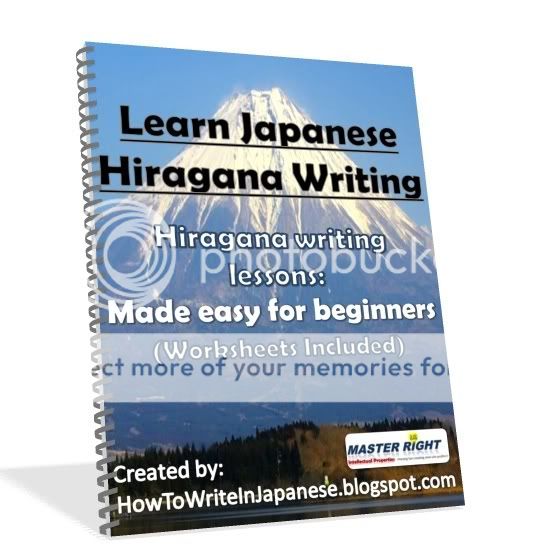
Hiragana Worksheet finally here!


This is a continuation of the previous post, How to write in Japanese - With the help of a Hiragana Table.

After trying to write out the Hiragana characters myself, I realise the untidiness of scribbling the characters across a blank paper. Therefore I've came out with the 'Hiragana Worksheet'!

Think you've got the best way of practicing Hiragana? Wait till you check my Hiragana Worksheet out.

Cool Features and Benefits:
  1. Each Hiragana character (showing it's correct stroke order) is included in the left-most square for quick and easy reference!
  2. Square boxes are drawn up to keep your writing practice neat
  3. Square boxes to help you keep track on the number of characters you've written
  4. Print as many copies as you want to practice! There's no limit.
Sample Picture of the worksheet:


Lastly, if you've found this useful, share it with your friends. Let them know how easy it is to practice Hiragana.

Cheers!
Continue Reading...

Saturday, September 19, 2009

How to Write Your Name in Japanese

#1

How to Write Your Name in Japanese <- The #1 question on the Internet!


Tons of free services online are available to help you with this. Just type "translate name into japanese" into Google (additional resources below). A very common reason people want to know how to write their name in Japanese is to use it for a tattoo design.

So How to Write Your Name in Japanese?


There are two popular ways to go about translating your name into Japanese
  1. Based on what your name means (will be written in Japanese Kanji character/s).
  2. Based on how your name is pronounced. (will be written in Japanese Katakana character/s, not Hiragana).
Nowadays, it's common to translate your name based on only the pronunciation. Although native Japanese names are written in kanji, as a non-Japanese, your name would be written in Katakana, which is used to write names and other non-Japanese words. (If you need to fill up an official document / form, it would instruct you to either write your name in English alphabets, or in Katakana.)

-> To see a Katakana translation of your name, go to http://japanesetranslator.co.uk/your-name-in-japanese/, enter your first name in the box provided and click on the 'Translate' button. It'll show you both the Romaji pronunciation as well as writing in Katakana. [Note: It's easier to read the katakana when you choose 'Sans-serif' as the style before clicking on the translate button.]

-> To see a Kanji translation of your name, go to http://www.yournameinjapanese.com/, enter your name in the box and click on the word 'Translate'. It'll show you the Romanji pronunciation, Kanji character(s) and meaning of the Kanji characters.

Have fun learning how to write your name in Japanese and embrace the Japanese in you!


< Previous : #2 "How to Write in Japanese"
Continue Reading...

How to Write I Love You in Japanese

#2

How to Write I Love You in Japanese


In Japanese, "love" is written as
Romaji : ai
Kanji :
Hiragana : あい

Thus, a direct translation of "I Love You" can be
Romaji : aishite imasu
Kanji : 愛しています
Hiragana : あいしています
[Images Source: Wikimedia Commons]
The "I Love You" you may hear in Japanese movies and drama serials is
Romaji : ai shiteru
Kanji : 愛してる
Hiragana : あいしてる
[Note: This version of "I love you" is usually only used between couples in a seriously committed relationship like marriage.]

Hence, a more commonly used and appropriate expression is "I like" :
Romaji : suki desu
Kanji : 好きです

or "I like very much" :
Romaji : daisuki
Kanji : だい好き

A less serious version of "I like you" is :
Romaji: sukidaiyo
Continue Reading...

How to Write Japan in Japanese

#3

How to Write Japan in Japanese

[Source: Wikimedia Commons]
English : Japan
Romaji : nihon
Kanji : 日本
Katakana : not used to write this.
Hiragana : にほん

Since the Japanese people are proud of their country, it would also be useful to know how to write "I love Japan" in Japanese.

English : "I love Japan"
Romaji : nihon daisuki
Kanji : 日本大好き
Katakana : not used for this expression.
Hiragana : にほだいすき


< Previous : #4 "How to Write in Japanese"
Continue Reading...

How to Write Happy Birthday in Japanese

#4

How to Write Happy Birthday in Japanese

Source: Wikimedia Commons
* "Happy Birthday" :
Romaji : tanjoubi omedetou
Kanji : 誕生日おめでとう


* More formal version of "Happy Birthday"
Romaji : tanjoubi omedetou gozaimasu
Kanji : 誕生日おめでとうございます


< Previous : #5 "How to Write in Japanese"
Continue Reading...

How to Write Hello in Japanese

#5

How to Write Hello in Japanese

[Source: Wikimedia Commons]
* Polite Hello / Good Afternoon :

Romaji : konnichiwa
Kanji : 今日は
Hiragana :  こんにちは

* Polite Good Morning :
Romaji : ohayou gozaimasu
Kanji : お早うございます
Hiragana : おはようございます

* Casual Good Morning :
Romaji : ohayoo
Kanji : お早う
Hiragana : おはよう

* Good Evening : 
Romaji : konbanwa
Kanji : 今晩は
Hiragana : こんばんは

The easiest way to greet people in Japan would be to say their name and nod your head as you pass.

< Previous : #6 "How to Write in Japanese"
Continue Reading...

How to Write a Letter in Japanese

#6

How to Write a Letter in Japanese


Many people do this to send a postcard to a Japanese penpal, friend or even long-lost family member. There was even a high-school student who was going to Japan for a student-exchange program, and wanted to write a letter to his host family to introduce himself.

Beginner's Way of Writing a Letter in Japanese


Here's a 'Simple 3-Step Approach' to write an informal letter to a friend in Japanese:

> Step 1. Start with a greeting and ice-breaker - show some concern for your friend by asking about their health, discuss the weather or send them some well-wishes.
Examples:
* "Have you been doing well?" is a common way to start your letter.
Romaji : ogenki desu ka
Kanji : お元気ですか。
* "How have you been?"
Romaji : Ikaga osugoshi desu ka.
Kanji : いかがお過ごしですか。

> Step 2. Include the details of the purpose of your letter.


> Step 3. End of with parting words like
    Examples:
    * "I look forward to hearing from you." - very polite.
    Romaji : o-henji tanoshimi ni shite masu.
    Kanji : お返事を楽しみにしています

    * "Bye! Later!" - commonly used among teenagers. Casual.
    Romaji : Matane
    Hiragana : またね

    If you need other expressions used in letters, visit here.

    [Note: Don't worry if you don't know how to write in Kanji or Hiragana yet. It's ok to write your letter in Romaji. Your friend will be able to understand.]

    < Previous : #7 "How to Write in Japanese"
    Continue Reading...

    How to Write Thank You in Japanese

    #7

    How to Write Thank You in Japanese


    [Source: Wikimedia Commons]
    The Japanese are very particular about being polite and respectful towards each other. So learning how to write and say 'Thank You' in Japanese is an essential skill you'll need when interacting with them.

    English : Thank You
    Romaji : arigatou
    Kanji : none
    Katakana : not used to write this.
    Hiragana :  ありがとう

    English : Thank You Very Much
    Romaji : doumo arigatou
    Kanji : none
    Katakana : not used to write this.
    Hiragana : どうもありがとう

    English : Polite way of saying 'Thank You'
    Romaji : arigatou gozaimasu
    Kanji : none
    Katakana : not used to write this.
    Hiragana : ありがとうございます


    < Previous : #8 "How to Write in Japanese"
    Continue Reading...

    Thursday, September 17, 2009

    How to write in Japanese - With the help of a Hiragana Table

    Ok! So here's how to write in Japanese, Hiragana style!
    1. Click here to print out the Hiragana table. (This is IMPORTANT because it shows you the correct strokes in sequence for every Hiragana character. Follow the numbers, and you won't go wrong.)
    2. After printing out the table, it's time to start writing! Start writing from the right column - 'a, i, u, e, o' = 'あいうえお' (Quick tip! Practice one column at a time for more efficient learning. Also, say out the word as you write it. It's an excellent technique to help you memorize better.)
    3. Once you are familar with the first column, continue writing the next column on the left. It's good to revise the previous column before starting a new one.
    4. When you've reached the end of the table, go back to the start and write each column 5 times. For example: あいうえお x 5.
    5. Repeat steps 2 - 4 till you are able to write all 46 Hiragana characters.

    Pretty simple task ya? Since there are 46 Hiragana characters, learn 5 characters each day to complete the table in 10 days!

    Cheers!

    Latest Update:
    Download the Hiragana Worksheet to practice NOW!
    Continue Reading...

    How to write in Japanese - Hiragana Table for Download


    Above is the Japanese Hiragana Table. With the help of the Hiragana table, it lets you practice writing in proper Japanese Hiragana style.

    Want to know more about using the table? ( This is the link )
    Continue Reading...

    Wednesday, September 16, 2009

    How to Write Numbers in Japanese

    #8

    How to Write Numbers in Japanese


    Modern day Japanese prefer to write numbers in roman numeral format (e.g. 1, 2, 3, etc.). The traditional way of writing numbers in Japanese, in Japanese symbols (Kanji) is only for formal writing.
    [Did you know? Japanese number characters originate from Chinese number characters.]
    * Note: Katakana is not commonly used to represent Japanese numbers because the purpose of Katakana is to represent non-Japanese-words / foreign-words / borrowed-words.


    Roman numeral : 1
    Romaji : ichi
    <-- Kanji
    Katakana : not used to write japanese numbers
    Hiragana : いち


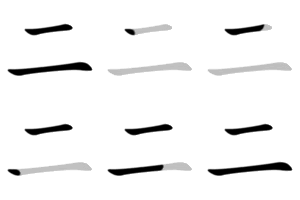
    Roman numeral : 2
    Romaji : ni
    <-- Kanji 
    Katakana : not used to write japanese numbers
    Hiragana :


    Roman numeral : 3
    Romaji : san
    <-- Kanji
    Katakana : not used to write japanese numbers
    Hiragana : さん


    Roman numeral : 4
    Romaji : yon
    <-- Kanji
    Katakana : not used to write japanese numbers
    Hiragana : よん


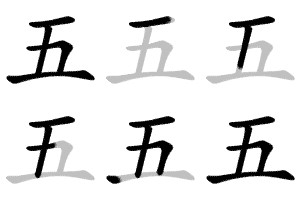
    Roman numeral : 5
    Romaji : go
    <-- Kanji
    Katakana : not used to write japanese numbers
    Hiragana :


    Roman numeral : 6
    Romaji : roku
    <-- Kanji
    Katakana : not used to write japanese numbers
    Hiragana : ろく


    Roman numeral : 7
    Romaji : nana
    <-- Kanji
    Katakana : not used to write japanese numbers
    Hiragana : なな


    Roman numeral : 8
    Romaji : hachi
    <-- Kanji
    Katakana : not used to write japanese numbers
    Hiragana : はち


    Roman numeral : 9
    Romaji : kyuu
    <-- Kanji
    Katakana : not used to write japanese numbers
    Hiragana : きゅう


    Roman numeral : 10
    Romaji : juu
    <-- Kanji
    Katakana : not used to write japanese numbers
    Hiragana : じゅう

    Roman numeral : 0

    Romaji : zero
    <-- Kanji
    Katakana : not used to write japanese numbers
    Hiragana : -

    To see how to write larger numbers in Japanese, here's a link to Wikipedia where there's even a section that shows you the Japanese symbol for numbers like 100, 10,000, 1036 and more.

    [Note: These images are courtesy of Wikimedia Commons]

    [ As an added resource, if you need an unusually effective way to memorize the pronunciation of Japanese numbers, here's an amusing page on WikiHow, that teaches you how to count in Japanese through DANCE! http://www.wikihow.com/Count-in-Japanese-Through-Dance# ]

    < Previous : #9 "How to Write in Japanese
    Continue Reading...

    How to Write Welcome in Japanese

    #9

    How to Write Welcome in Japanese


    A common reason people want to know how to write 'Welcome' in Japanese is so they can welcome people to their blog, website or even on MySpace.


    So how DO you write welcome in Japanese?                                            


    Depending on the situation,
    • The most common and general way to greet others:
              Romaji : Youkoso (pronounce "ou" as a long "ohhh")
              Hiragana : ようこそ
    • To receive a delegation or group of important people, the most formal way of saying welcome:
              Romanji : Kangei (pronounce "ei" as a long "ayyy")
              Kanji : 歓迎
              Hiragana : かんげい
    • To welcome customers stepping into a shop or into your house informally:
              Romaji : Irasshai
              Hiragana : いらっしゃい
    • To welcome customers stepping into a shop or into your house formally:
              Romaji : Irasshaimase
              Hiragana : いらっしゃいませ

    • "Welcome home":
              Romaji : Okaeri
              Hiragana : おかえり
    • "You're welcome", as a response to someone thanking you:
              Romaji : Dou itashimashite
              Kanji : お願いします
              Hiragana : どういたしまして
    • To invite someone to eat or to enter a room or to take a seat:
              Romaji : Douzo (pronounce "ou" as a long "ohhh")
              Hiragana : どうぞ

    [Note: If you don't see the word you want in any form, it's because
    1. There is no representing character for this word in Kanji.
    2. This phrase is not written in Katakana because it's not a foreign-word/ non-native-word/ borrowed-word.]

    If you're interested, here's a video of the Twitter team saying 'Welcome' or "Youkoso", as part of their launch of Japanese Twitter (http://twitter.jp). http://www.youtube.com/watch?v=MUIvNkwjk5A

    < Previous : #10 "How to Write in Japanese
    Continue Reading...

    How to Write Merry Christmas in Japanese

    #10

    How to Write Merry Christmas in Japanese


    While it's self-explanatory that people want to know how to write 'Merry Christmas' in Japanese so they can send cards and greet their friends on email, what you may not know, is that:
    1. Not only is December 25th NOT a national holiday in Japan (probably because according to Wikipedia, Christians only make up an estimated 1% of the Japanese population), 
    2. Christmas Eve is treated more like how Valentine's Day is treated in the West - as a day for romance and an opportune time to express your love to someone. This is largely due to the media-hype in Japan.

    How to Write Merry Christmas in Japanese


    There are no Japanese symbols (Kanji) to represent "Merry Christmas". Instead, it's translated into the Japanese pronunciation as "Merii Kurisumasu".

    Since it's a non-Japanese expression / foreign word, native Japanese people commonly write this phrase in Katakana or just in plain English as "Merry Xmas" or "Merry Christmas".

    Incidentally, most Japanese understand these English words " Merry Xmas" or "Merry Christmas" because they're so well-known all over the world.

    Romaji: Merii Kurisumasu

    Kanji: None
    Katakana: メリークリスマス
    Hiragana: めりいくりすます

    Continue Reading...

    Top 10 Things that People want to know How to Write in Japanese


    There's a long list of words, phrases and things that people want to know how to write in Japanese, and their reasons for doing so are wide and varied.

    This list is presented in ascending order of popularity; organized to include insights into why people are searching to write these words in Japanese, as well the actual ways to write these words in Japanese. In many cases, there's more than one way to express a word. And thanks to the four different Japanese writing systems (Hiragana, Katakana, Kanji and Romaji), many forms of the same word.

    To make it more interesting, see if you can guess what's the Number 1 subject being searched to be written in Japanese...

    (Hint: Human Nature)

    Continue Reading...

    About HowToWriteInJapanese.blogspot.com

    Youkoso! Hi and Welcome to HowToWriteInJapanese.blogspot.com!

    This site was birthed in response to the thousands of people asking the question "how to write in japanese"? on the Internet.

    The three focused intentions for this site are:
    1. To be profitable selling relevant products to visitors.
    2. To provide visitors with valuable, relevant and honest info.  
    3. To have fun during the entire process.
    Arigatoo Gozaimasu (thank you) for visiting our site.
    We hope you've had a pleasant experience with us.

    Do take a look and consider our product offer(s).
    We also appreciate you taking the time and effort to share us with your friends.

    Wishing you all the best. We look forward to seeing you here again. :)
    Continue Reading...

    Saturday, September 12, 2009

    How to Write in Japanese - Advice to a Friend

    When a friend of mine sought my advice regarding her interest in learning Japanese, I said...

    "Writing in Japanese can either be very easy or very difficult. Attitude aside, I firmly believe that a lot depends on whether you've found a system or method of teaching and learning that is suitable and works well for YOU.

    The reason I say this is because unless you're being forced by law to learn Japanese, clearly, the only reason anybody would choose to do so is because they have a desire and interest to do so.

    Since there's desire and interest in the subject, why then, aren't more people able to speak, read and write in Japanese fluently?

    IMHO (in my humble opinion), I say don't blame the student, don't blame the teacher, blame the system.

    Traditionally, there are two basic ways to approach learning how to write in japanese:

    1. Ad-hoc - you have a phrase in mind that you want to learn how translate into japanese and
    2. Academic / Methodical - you want to start from the basics and work your way up towards being able to read, write and speak Japanese as an additional language.

    I think ad-hoc works if you're extremely passionate about the subject and are eager to learn. But if that's the case, you'd probably also do extremely well in an academic environment, and might be better off doing so - since you can get certified and use it to further your career and everything.

    But for the average person who's interested but not yet passionate (namely me), I would advise against taking a formal class unless you're the seriously bookish and studious type who takes pleasure in stiff classroom environments.

    Having attended formal classes myself, I found the classes to be instructive and even helpful. But the structure and formality of attending classes week by week didn't sit well with me. Don't get me wrong. I have a serious interest and desire to learn Japanese. But attending the classes somehow left me feeling stifled and very, very bored.

    I stopped going of course.

    Since you're willing to pay to learn Japanese, I think it makes sense that you find a system, teacher or something, that allows you to learn in way that's personally comfortable, enjoyable and pleasing to you.
    We're not in school anymore. We have the right, choice and responsibility to ourselves (and to our money) to do what's right for us. We deserve to do what feels good.

    My previous formal japanese class experience has shown me that I'd much rather learn at my own time and pace, from the comforts of my home, where I don't have to suffer or endure the inane questions of other
    clueless students-of-japanese when I'm eager to move forward with the lesson.

    Only you know what's right for you.

    In conclusion, I recommend that you shop around and look for a program that really suits YOU. If you want to meet other people and have classmates, a formal classroom style could be your thing. Otherwise, I'd strongly recommend purchasing an online program like Rocket Japanese so you can learn and discover at your own time and place. Best of all, online programs give you a money-back guarantee. I've not yet come across a formal japanese language school that gives you that.

    Lots of Love,
    Rachel"

     I figured that having an online Japanese language classroom allows me to learn more effectively as compared to learning from a language school. I found the solution to get rid of the boring teachers and routine classes. Find out how I managed to do that with just a few clicks of the mouse....


    [More...]

    Continue Reading...
     

    Share This!

    Bookmark and Share

    Join Us on Facebook

    Advertisement

    ButtonGenerator.com

    How to Write in Japanese Copyright © 2009 WoodMag is Designed by Ipietoon for Free Blogger Template | SEO by: Templates Block